Course Element "Video task"
Profile
| Name | Video Task |
|---|---|
| Icon |  |
| Available since | Release 17.2 |
| Functional group | Assessment |
| Purpose | Enables assessment tasks in a video |
| Assessable | yes |
| Specialty / Note | Additional quizzes included in the video are not assessable |
With the course element "Video task" OpenOlat video learning resources can be reused for interactive (formative) exercises or tasks with assessments (summative). Participants have to identify relevant situations in a video and assign them to a category. The necessary placeholders in the video (= segments) and the categories are defined in the learning resource "Video" (see Video Editor). A practice mode and a sharp test mode are available.
Tasks
Exercise: Matching terms
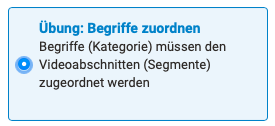
In this mode, the segments (video sections) in the video are marked.
Example:
- The video shows the process of a medical care treatment.
- In the lower area of the video, steps of the treatment are shown.
- While the video is playing, the appropriate name of the measure (category term) must be clicked on during the recognised step.
- Feedback is given immediately after a term is selected.
- Manual assessment by coaches is not possible. (=> Practicing should be possible without control).
Exercise: Recognizing situations
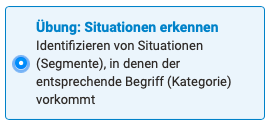
In this mode, the segments (video sections) in the video are not marked.
Example:
- The video shows a counselling session.
- No segments (video sections) are marked in the lower area of the video.
- While the video is playing, the student has to identify which phase of the conversation it is.
- The feedback is given immediately after the selection of a term.
- Manual assessment by coaches is not possible. (=> Practicing should be possible without control).
Test: Recognizing situations
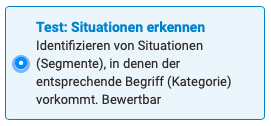
In this mode, the segments (video sections) in the video are not marked.
Unlike the exercise, the test is assessable.
Example:
- The video shows a counselling session.
- No segments (video sections) are marked in the lower part of the video.
- While the video is playing, the learner has to identify which phase of the conversation it is.
- During a test, the participants do not receive any feedback.
- At the end, it is only indicated that an automatic assessment has been made. However, the detailed evaluation result is only visible to the coach or owner.
Note
In addition to the 3 tasks with segments, quiz questions can also be displayed at different times in the video. However, they are currently not taken into account in the assessment.
Practice mode - Test mode
When practicing, the results should remain anonymous. Coaches therefore only see anonymously presented results. In tests, on the other hand, the entries are assessed by the coaches.
The number of solution attempts can be limited (1-9999).
In the exercise mode "Assign terms", the number of answer attempts per segment can also be limited (1-5).
Required Learning Resource
A video learning resource must be inserted into each course element "Video task".
This is an mp4 file uploaded to the authoring area or a link to an online resource (e.g. Youtube).
The following elements can be added to an mp4 file in OpenOlat. The mp4 file together with these elements forms the OpenOlat video learning resource. It is listed in the authoring area.
In order to be able to assign segments (video sections), a video task necessarily requires a video learning resource in which segments have been created.
| Elements of the Learning resource: | |
|---|---|
| Chapter | optional |
| Notes | optional |
| Segments | Required for a video task |
| Comments | optional |
| Quiz | optional (not assessed) |
Tip
If a link (e.g. YouTube) is used for the video learning resource, it should be considered that if the link is no longer valid, the video task becomes unusable. We therefore recommend uploading an mp4 file to OpenOlat if possible.
Create Video task
Step 1
Create a video learning resource in the authoring area.
Open the video editor and add segments and terms.
Find out more >
Step 2
Add a "Video Assignment" course block to the course.
Step 3
In the course element, "Configuration" tab a) Insert the video learning resource that has been divided into segments, and b) Select the desired mode.
Step 4
Make sure that in the "Configuration" tab
- Segments are displayed as video elements
- The correct terms are used
- The order of the terms in the video assignment is correct
Tip
- Click "Edit Learning Resource" to open the video editor and continue editing the segment assignments.
Assessment
Principles
- For exercises, the assessment is automatic. It cannot be changed by the coach.
- Tests are also assessed automatically. Coaches can view all solution attempts in the assessment tool and decide whether to approve the assessment.
- Quiz questions contained in a video learning resource are currently not included in the evaluation. In the course element video task the evaluation refers exclusively to the segments.
- In exercises, the results should remain anonymous. Coaches therefore only see anonymously presented results.
- Incorrect answers are weighted using the following formula:
t = total number of segments
c = number of correctly identified segments
w = wrong clicks
g = Weighting wrong clicks
Result % = (c / t) - (w / t * g) -> However, it cannot be less than 0%
Score = max. score * result
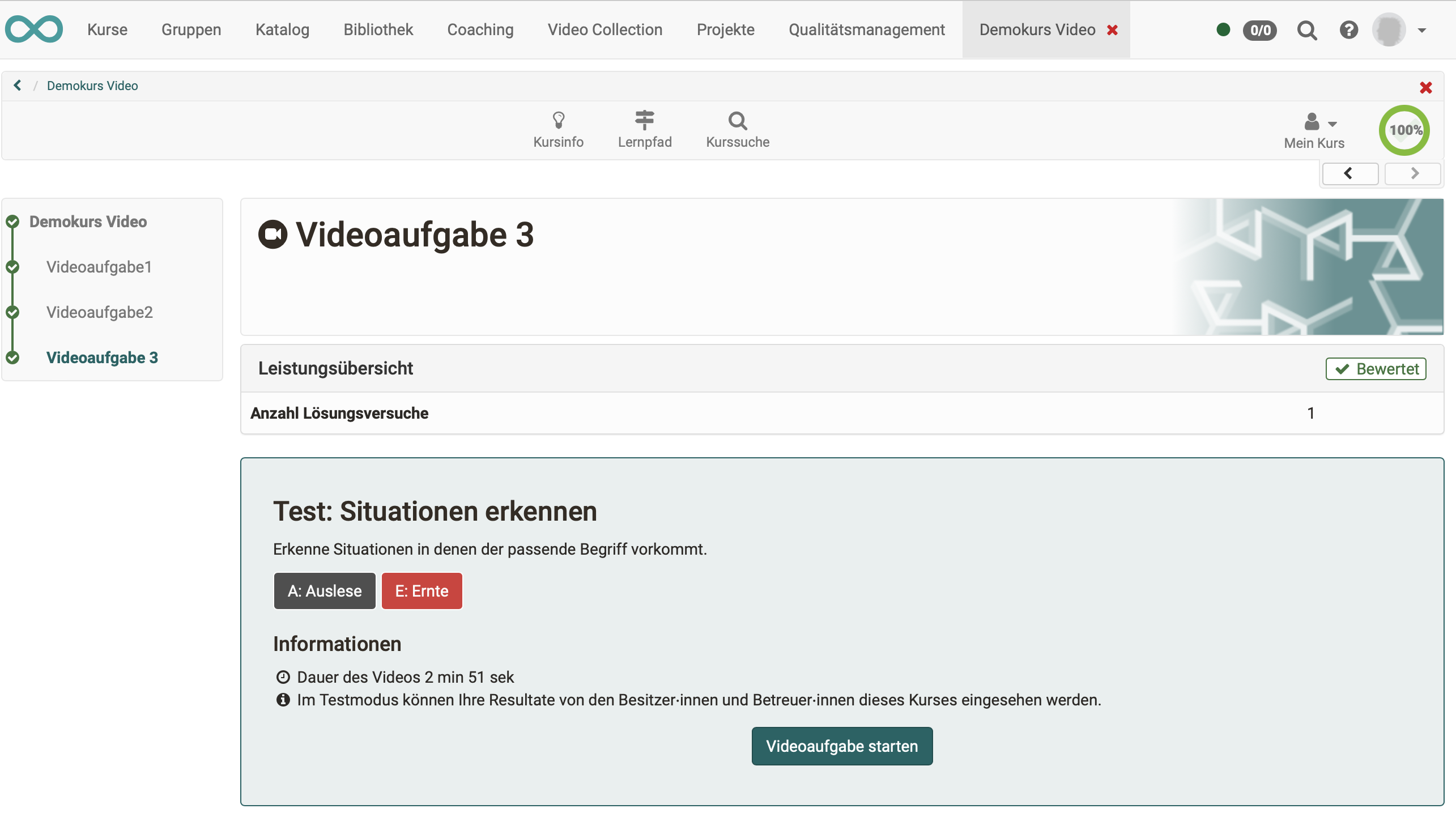
Result for participants
In exercises, participants receive immediate feedback while solving the task.
In addition, a summary is displayed at the end of the exercise and the solution can be viewed.
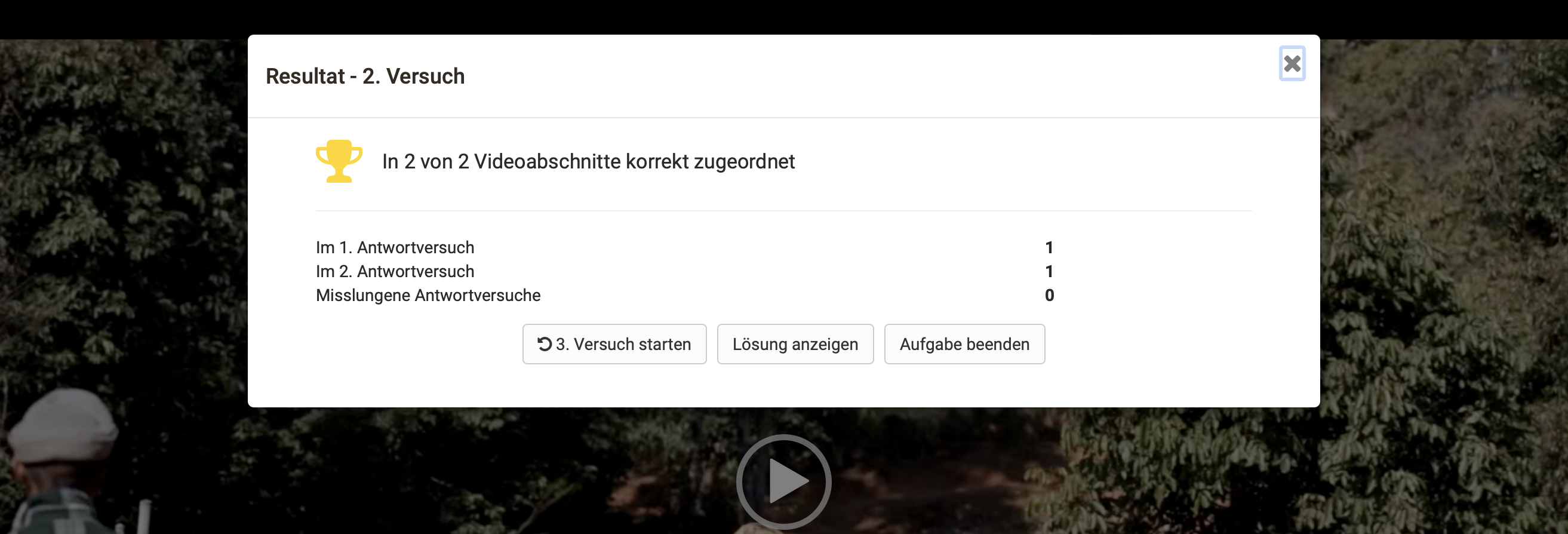
During a test, on the other hand, the participants do not receive any feedback. At the end, only the number of attempts to solve the problem is displayed. (If further attempts are allowed, the task definition and the button for starting the video task will also appear again.)
Results for coaches in exercises
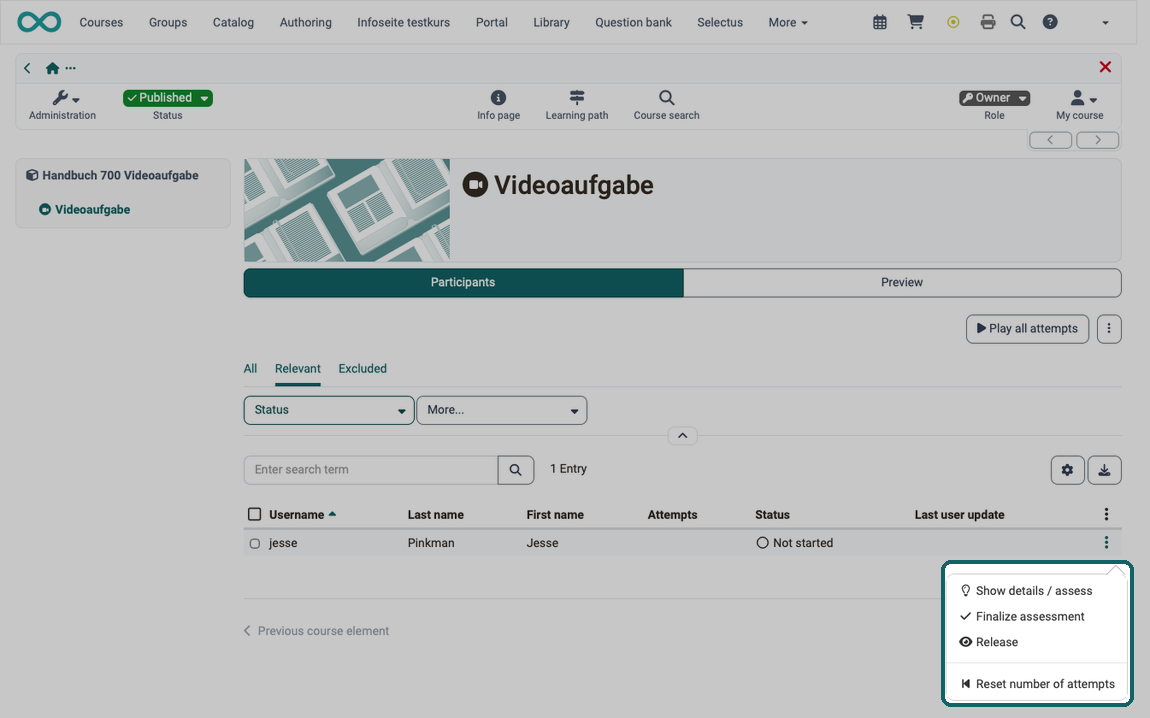
If in exercises coaches open a course element with a video task in the course menu, they will see the two tabs "Participants" and "Preview".
- In the tab "Participants" the processing status of the coached course participants is displayed in a list.
- In the "Preview" tab, the video is displayed as seen by participants.
In the menu with three dots in the row of a participant, coaches find these entries, depending on the status of the assessment and on the course settings:
- Show details / assess opens the assessment of the person.
- Finalize assessment or Reopen assessment changes the status of the assessment.
- Release or Withdraw release defines whether the person sees their result.
- Reset number of attempts resets the attempts of the person.
You delete the data of all participants with the entry "Delete all data", see below.
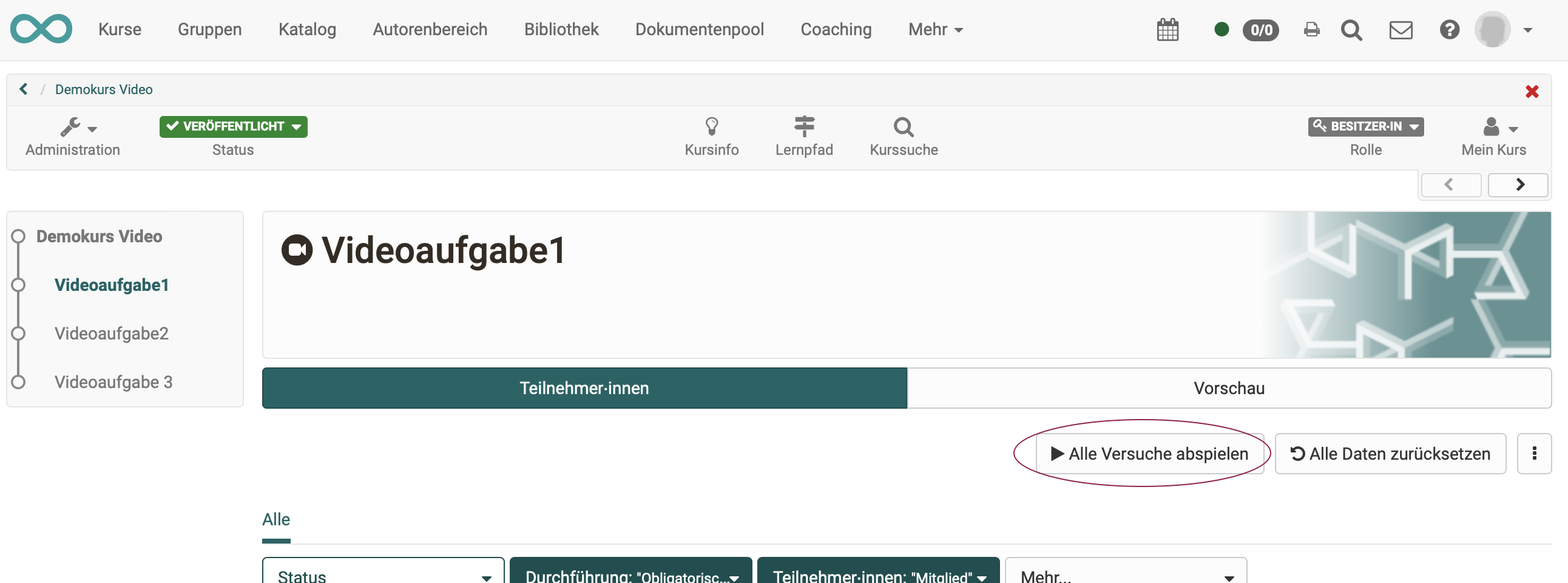
"Play all attempts" button
As the experiments are to remain anonymous during exercises, coaches cannot see any results that can be attributed to specific persons. Instead, the attempts of all participants are shown as strokes in a common display.
To do this, click the button "Play all attempts".
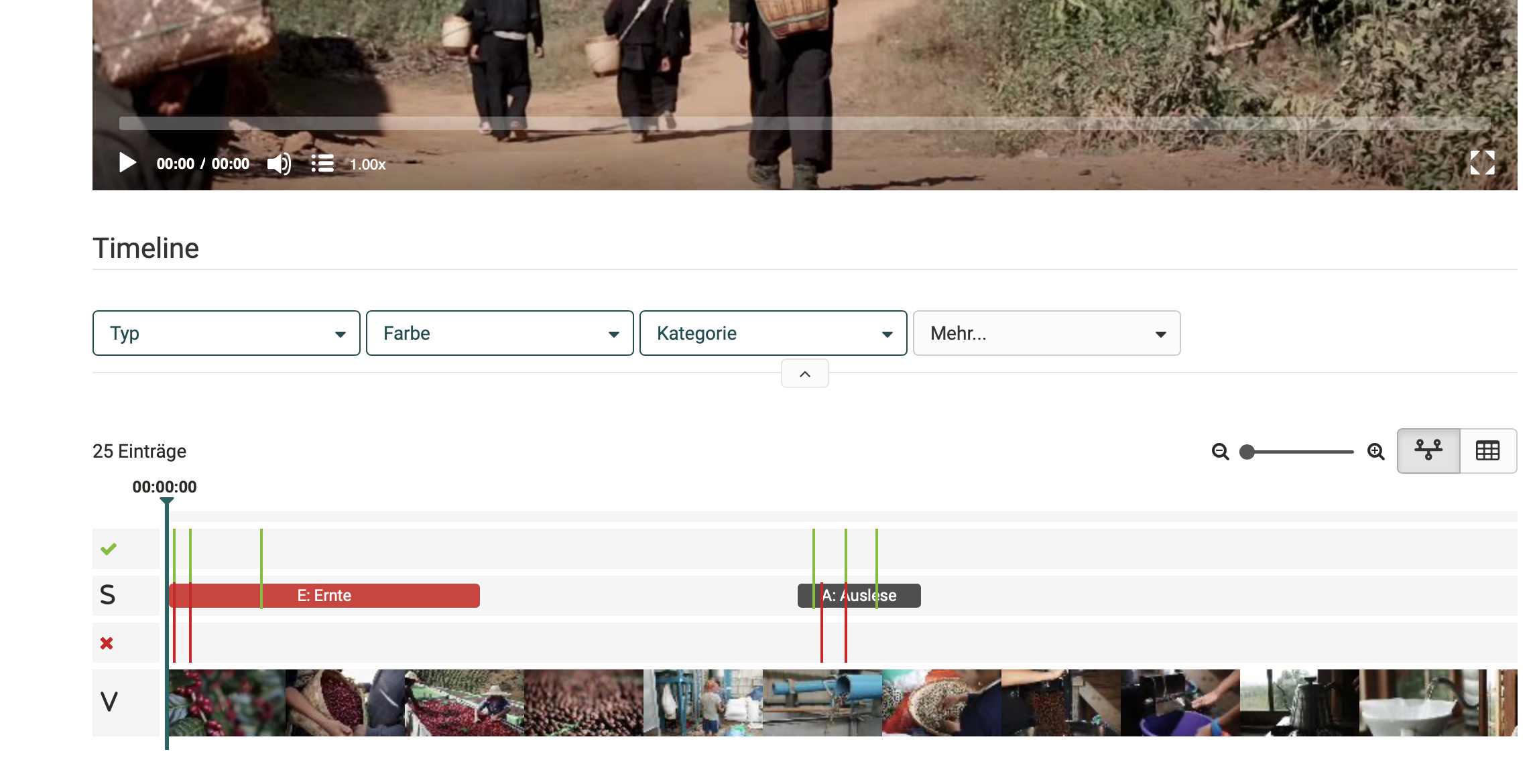
In the timeline of the video, all successful answers are shown as green lines, the wrong answers as red lines. Coaches can thus draw conclusions about widespread knowledge gaps among the participants. However, the results presented in this way may also indicate that the task should perhaps be adapted.
"Delete all data"
You find the entry "Delete all data" in the menu with three dots next to the buttons of the "Participants" tab.
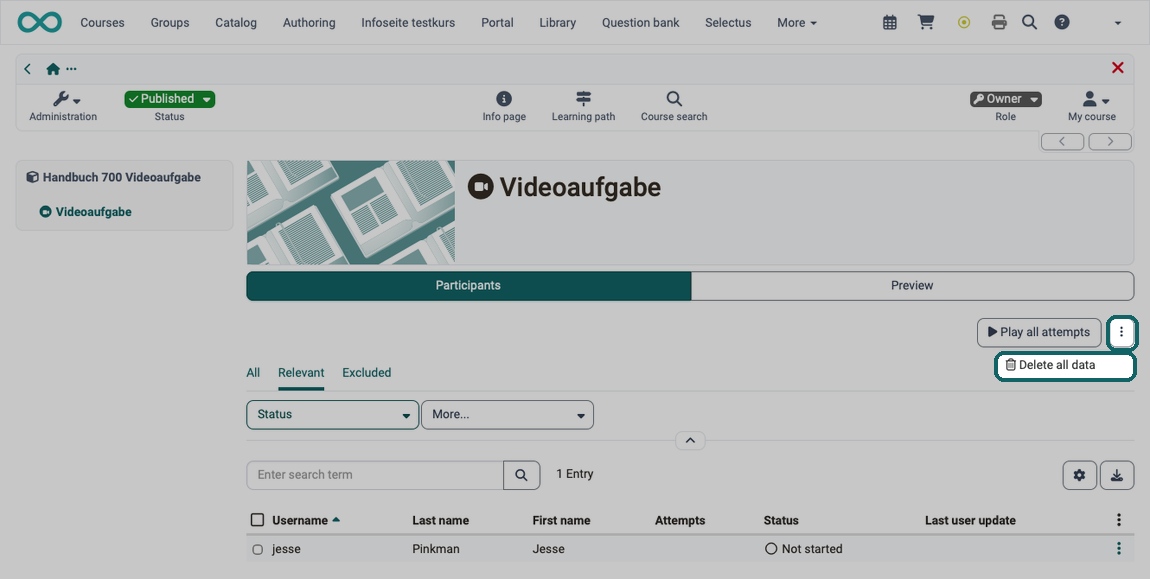
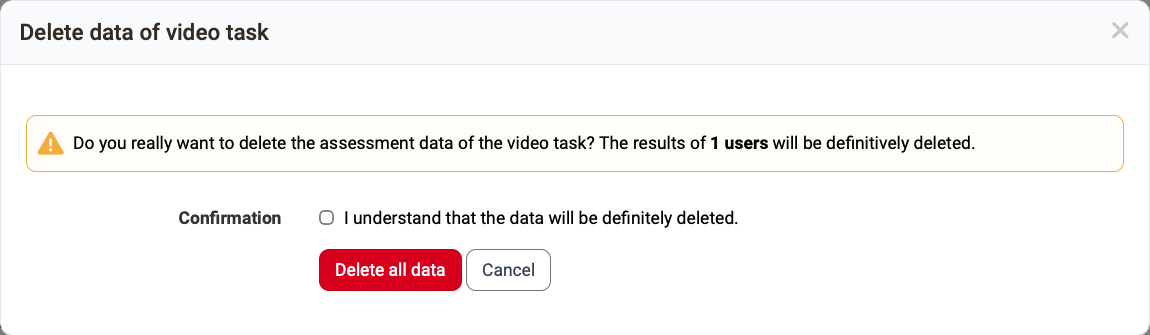
After clicking on the entry, the dialog "Delete data of video task" appears. It names the number of persons whose results are permanently deleted. You confirm the checkbox "I understand that the data will be definitely deleted." and click "Delete all data". Before deleting, OpenOlat creates an archive file with the previous data.
Results for test coaches
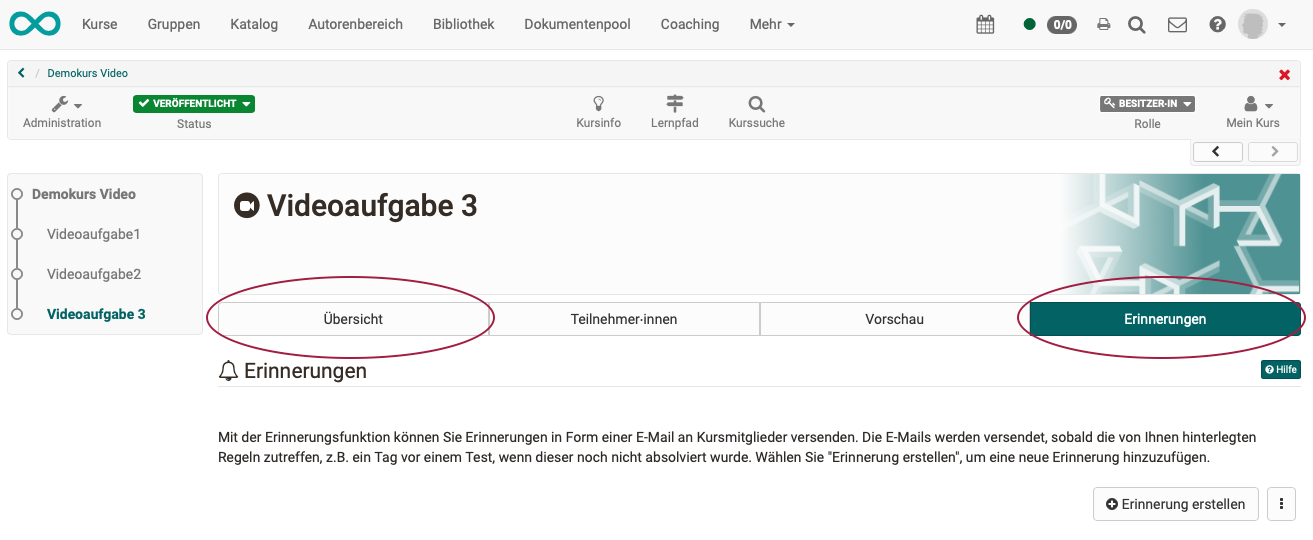
If the mode "Test" was selected for the video task, the Tabs "Participants" and "Preview" as well as the Tabs "Overview" and "Reminders" appear. In the "Reminders" tab, coaches can set up automatic e-mails to course members that are sent as soon as the configured rules apply, for example one day before a test that has not yet been completed.
All results can be viewed by the owners and coaches of this course in detail for each participant in the tab "Participants".