To-dos: basics
A to-do is a task with a responsible person and a date. OpenOlat provides to-dos in several modules, everywhere with the same fields and the same status model. This page describes what applies to all to-dos. How you work with them in a module is described on that module's page.
Where are to-dos available?
Tasks are recorded where they arise. In the personal menu they come together.
| Place | What is recorded there |
|---|---|
| Personal menu | All your to-dos from all modules in one list, plus your own to-dos without a module reference |
| Project | Tasks within a project, linkable with files, dates and decisions |
| Course | Tasks concerning the course, created under Course > Administration > To-dos |
| Course element Task | To-dos that the course element assigns automatically. They serve as information and cannot be edited or deleted |
| Course Planner | Tasks on every element of a product, plus a central overview across all products |
| Quality management | Actions that result from a data collection |
The fields of a to-do
Whoever creates a to-do finds the same fields in every module. Two entries exist in one module only.
| Field | Meaning | Available |
|---|---|---|
| Title | Names the task. Choose a self-explanatory title | everywhere, mandatory field |
| Assigned | The person responsible for completing the task | everywhere, mandatory field except in the Course Planner; for personal to-dos only if the administration allows assignment to other persons |
| Delegated | Execution can be delegated to other persons, also to changing persons over time. Responsibility remains with the assigned person | everywhere; for personal to-dos only if the administration allows delegation to other persons |
| Status | The processing state of the task | everywhere |
| Priority | Urgent, High, Medium or Low | everywhere |
| Start date | When the task starts. Can be used for reminders | everywhere |
| Due date | The date by which the task should be completed | everywhere |
| Expenditure of work | The estimated effort in weeks (w), days (d) and hours (h), input format 3w 1d 6h. The value can be used for calculations |
everywhere |
| Tags | Freely assignable keywords | everywhere |
| Description | Additional information about the task | everywhere |
| Context | Module and object the to-do originates from. In the list as the columns "Context type" and "Context" | everywhere |
| Metadata | "Created" and "Last modified" (in the project: "Modified"), each with date and person. The collapsible section appears in the dialog once the to-do exists. In the project and in quality management it additionally lists all changes | everywhere |
| Links | Links the to-do with files, dates and decisions | project only |
| Relative dates | Start date and due date based on the implementation period instead of a fixed calendar date | Course Planner only |
Tags you have created once are available for selection in other to-dos as well. They are not a hierarchically structured classification like the taxonomy that OpenOlat offers elsewhere.
Status and quick actions
| Status | Meaning |
|---|---|
| Open | The task has been created but not yet started |
| In progress | Work on the task has begun |
| Done | The task is completed |
| Deleted | The to-do is removed and only visible via the "Deleted" filter |
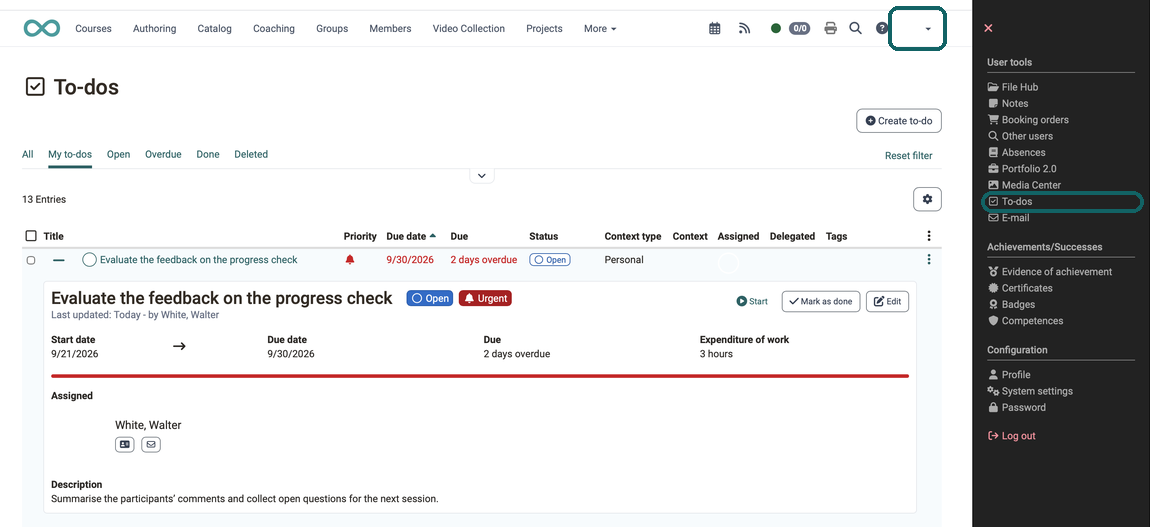
In the list, the status appears as a coloured circle next to the title. Use the plus sign at the start of a row to expand the detail area. There you change the state without opening the dialog:
- "Start" sets the status to "In progress". The action only appears with the status "Open".
- "Mark as done" completes the task. The action appears with the statuses "Open" and "In progress".
- "Edit" opens the dialog with all fields.
If start date and due date are both set, the list additionally shows a progress bar.
The image at the top of the page shows the status circles and the expanded detail area with the quick actions.
Who may edit a to-do
Editing permissions are held by the person who created the to-do, by the assigned and by the delegated person. Which roles may edit in addition is determined by the module: in the project the project management. In the Course Planner, administrators, course planners, product owners and element owners edit the to-dos; assigned and delegated persons only change the status there.
You delete to-dos where they were created. In the personal to-do list you delete your personal to-dos and the to-dos for which the module allows the assigned person to delete them.
When OpenOlat sends e-mails about to-dos
Whoever is to take on a to-do learns about it by e-mail and does not have to check the to-do list first. OpenOlat sends e-mails about to-dos in two cases:
- The e-mail "New to-do" goes to whoever is newly entered under "Assigned" or "Delegated" for a to-do. It names the title of the to-do and contains a link to it. If a person changes from "Assigned" to "Delegated" or vice versa, no e-mail is sent.
- The e-mail "To-do done" goes to the person who created the to-do and to the assigned and the delegated persons as soon as the to-do receives the status "Done". Whoever completes the to-do does not receive one. To-dos from the course element "Task" do not trigger this e-mail.
In the Course Planner, in the project, in quality management and for personal to-dos, whoever enters themselves receives no e-mail. E-mails about to-dos only go to persons with an active account.
In the Course Planner, OpenOlat combines the assignments of one operation. If a copy with "Copy element" or the bulk action "Create to-dos" assigns several to-dos to the same person, that person receives a single e-mail "New to-dos". It states the number of to-dos and lists one line with title and link per to-do. With more than 20 to-dos it shows the first 20 and below them the line "… and N more", where N stands for the number of remaining to-dos. If a person receives only one to-do from the operation, the e-mail "New to-do" is sent. OpenOlat sends the e-mails only once the operation is completed.
There is no setting that switches off e-mails about to-dos. When copying an implementation, no e-mails are sent if you choose the option "To-dos only" or "Don't copy" under "To-dos": Adopt to-dos when copying
Further information
Mentioned on this page
User tools: To-dos >
Projects: To-dos >
To-dos in the course >
Course Element "Task" >
Course Planner: To-dos >
Quality Management: Actions (To-dos) >
Course Planner: Implementations >
Further reading
Module To-do (Admin) >
Personal menu >