LTI - External Platforms
OpenOlat as "Tool"
If OpenOlat is used as a "tool" in the sense of the LTI terminology, existing courses in OpenOlat are displayed on another LMS. OpenOlat must provide information on the receiving platform (consumer) to ensure smooth communication between the two systems.
Administrators configure the interaction with the other platforms (also "platform" in the sense of LTI terminology) in the system administration under: Administration > External tools > LTI, tab "External platforms". OpenOlat is then the tool into which the course from the platforms defined here is integrated.
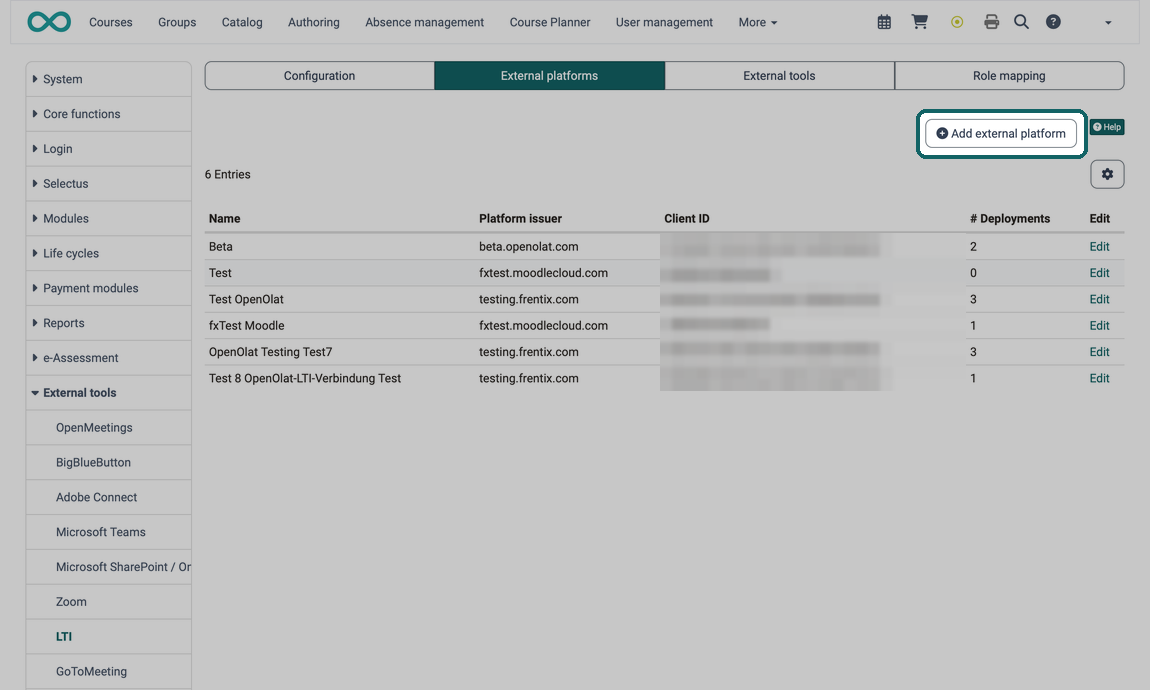
A separate configuration must be set up for each external platform. Use the "Add external platform" button to create the connection to a new platform.
The list shows the name, the platform issuer and the client ID of each platform. The "# Deployments" column counts the LTI shares of courses and groups that use this platform. With "Edit" you open the configuration of a platform again.
Important
If several different OpenOlat courses are used from the same external platform, it is sufficient to configure the external platform only once in the system administration. The LTI share per course is created in the settings of the respective course: Course > Administration > Settings > Share, section "LTI 1.3 access configuration". The same applies to groups in the "Share" tab of the group. Who may create it is described under Who can add deployments? If the platform sends the same deployment ID for several courses, each of these courses gets its own LTI share with this deployment ID.
Configuration
You can find a sample of an entire configuration under Configure LTI access to a course.
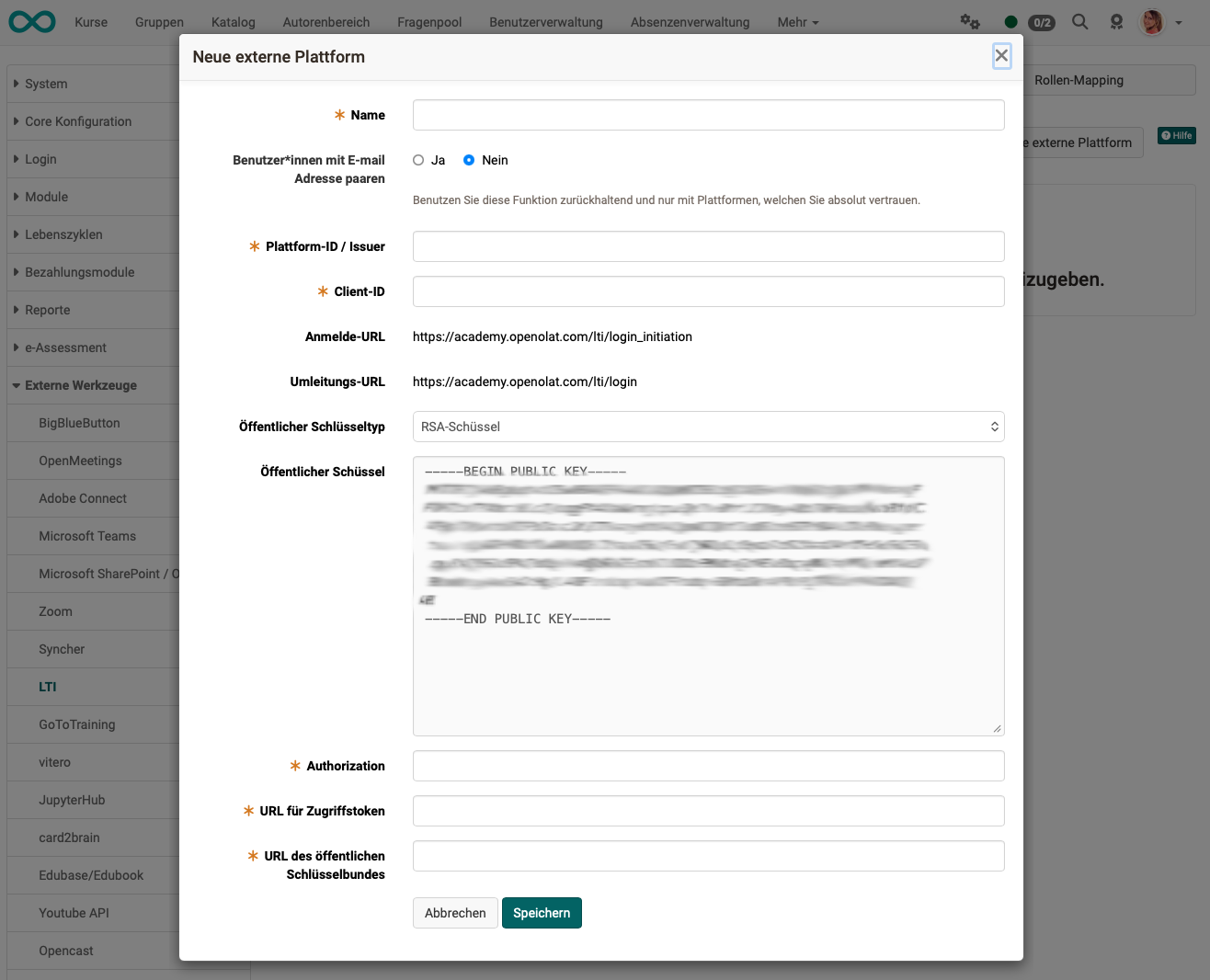
In OpenOlat, the following details of the external platform are recorded in the "Add external platform" dialog:
| Field | Comment |
|---|---|
| Name | Freely definable. Mandatory field |
| Match users by E-mail | Default "No". With "Yes", OpenOlat links a person who accesses from the external platform for the first time to the existing OpenOlat account that carries the same e-mail address, instead of creating a new account. This only works if e-mail addresses must be unique in the system and exactly one account with this address exists. Enable the option only for platforms you trust |
| Platform ID / Issuer | URL to the external platform. Mandatory field |
| Client ID | Client ID from the "Tool configuration details" dialog in the external platform. Mandatory field |
| Initiate login URL | Provided by OpenOlat, read-only. Enter this URL in the external platform as the initiate login URL |
| Redirection URL | Provided by OpenOlat, read-only. Enter this URL in the external platform as the redirection URL |
| Public Key Type | "Public Key" (default) or "URL". The selection determines whether OpenOlat shows the public key or the public key URL below |
| Public Key / Public Key URL | Generated by OpenOlat, read-only. You then enter this key or this URL in the tool configuration of the external platform |
| Authorization | From the external platform: Authentication request URL. Mandatory field |
| Token URI | From the external platform: Access token URL. Mandatory field |
| JWK-Set URI | From the external platform: Public Keyset URL. Mandatory field |
After completing the form, enter the public key on the external platform in the tool configuration there.
Further information
Mentioned on this page
LTI 1.3 Integrations >
Configure LTI access to a course >
Further reading
Learning Tools Interoperability Core Specification (IMS Global Learning Consortium) >
LTI - External tools >
LTI - Deep Linking >
LTI - Role mapping >
Course element "LTI Page" >
Configure LTI access to a group >