Badges
What is a badge?
Open Badges is a system of digital certificates or learning badges that you can use to award individual progress.
A badge is online proof that a goal has been achieved. It consists of
- an image (svg or png)
- (possibly with an editable key term on the image)
- meta information (description of the goal achieved, period of validity of the badge, issuer of the badge, date of issue, etc.)
- a link
The difference between a paper certificate and an online badge is that the badge can be shared online via links. For example, it can be included in a CV or portfolio. For example, a badge recipient can also include the badges on their LinkedIn profile.
In contrast to a formal certificate, the idea of the badge is more playful (gamification, to loosen up and motivate, the learners gain something).
Where can badges be acquired?
Basically 3 categories of badges can be acquired:
- Badges for a course
(for passing the course or fulfilling the conditions set out there) - Badges for a specific course element
(like course badges, with a condition for a specific course element, see list of course elements with badges) - and global badges
(cross-course, can only be created by administrators)
Global badges are independent of courses. Other badges relate to a specific course element or course. The same badge cannot be awarded in different places, e.g. for different course elements.
How are course badges awarded?
Course badges can be awarded manually or automatically based on defined rules.
Assign course badges manually
In each course, under
Course > Administration > Settings > "Assessment" tab > "Badges" section
manual assignment by course owners and coaches is made possible.
Award course badges in the assessment tool
Badges can also be awarded manually in the assessment tool via a mass action.
Course badges assigned automatically
When creating a badge with the wizard, rules for the automatic awarding of a badge can be defined in the "Award criteria" step. Multiple rules are combined with "And". The badge is awarded as soon as all conditions are met.
The following criteria are available for course badges:
- Course is passed: The course is passed.
- Course score: The course score reaches a defined comparison value.
- Course element passed: The selected assessable course element is passed.
- Course element score: The score of an assessable course element reaches a defined comparison value.
- Another badge has already been earned: Another badge of this course has already been earned.
In learning path courses, the following criteria are additionally available:
- Course element completion criterion met : The completion criterion of the selected course element is met.
- Learning path progress: The course progress reaches a defined percentage.
The selection for "Course element passed" and "Course element score" contains the assessable course elements of the course, e.g. test, task or checklist. Structure course elements cannot be selected. For a badge after completing a course section, therefore select the assessable course elements within this section as conditions.
How are global badges awarded?
Global badges can also be assigned manually or automatically based on defined rules. However, both manual assignment and the definition of rules for the automatic assignment of global badges can only be carried out by administrators.
Assign global badges manually
Global badges can be assigned manually by administrators in the system administration under
Administration > e-Assessment > OpenBadges > "Global Badges" tab > Button "Award manually"
Global badges assigned automatically
Administrators can set up the rules for automatic assignment in the system administration under
Administration > e-Assessment > OpenBadges > "Global Badges" tab
If the badge tool for creating a global badge is called up there, the rules can be specified in the wizard.
The following criteria are available for global badges:
- Courses passed: The selected published courses are passed.
- Badges earned: The selected other global badges have already been earned.
Create and edit a badge
Badges can only be created within a course by course owners.
Where can badges for course elements be created?
In the course editor:
Assessable course elements have an additional tab "Badges" as soon as the toggle "Award badges" is switched on in the course under Course > Administration > Settings > "Assessment" tab > "Badges" section. There you will find the button "Create a new badge".
The tab is available in the course elements:
- Test
- SCORM 1.2, if the course element returns a score or "Passed"
- Task
- Group task
- Assessment
- Check list
- LTI page
- Portfolio task
- Video task in the mode "Test: Identify situations"
- Structure, if a score or "Passed" is calculated for the course element
Where can badges be created for the course?
In the course editor:
If you click on the top "node", the course title in the course menu, a "Badges" tab will also appear on the right. As with the course elements, you can create a badge there by clicking on the "Create a new badge" button. Here, however, the badge refers to the course as a whole.
In the course administration:
Under Course > Administration > Badges a list of all badges that can be acquired in this course appears. The "Create a new badge" button can be used to create additional badges for the course and/or individual course elements.
You can find a step-by-step instruction for course badges here
Where can global badges be created?
The option to create global badges is described here.
Badge tool
Badges are created in the badge tool. A wizard guides you through the creation process.
The tool is used (with minor differences) for both course badges and global badges.
The wizard
As soon as you have decided to create a new badge (click on the "Create a new badge" button), a wizard will guide you through the creation process step by step.
If you are already the owner of a course with a course badge, the wizard for course badges starts with the "Starting point" step. There you choose "Create a new badge" or "Create from existing badge". With the second option, you adopt the details of an existing badge and adapt them in the following steps. The wizard then skips the "Image" and "Customization" steps.
-
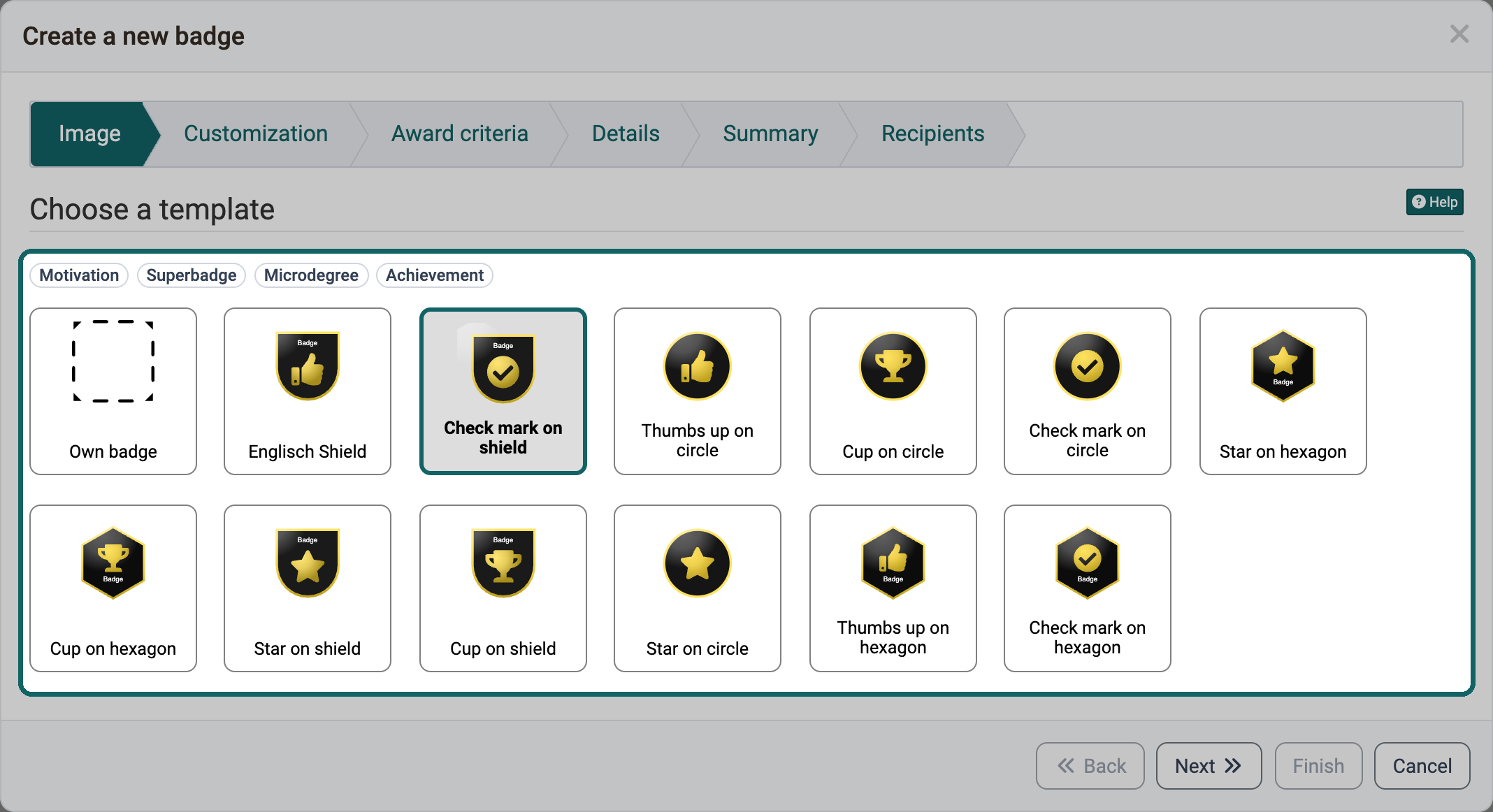
Image: The first step is to select a template or upload your own image. OpenOlat supports the image formats SVG and PNG. For your own image, select "Own badge" and upload the file. With the categories above the templates, you narrow down the selection.
-
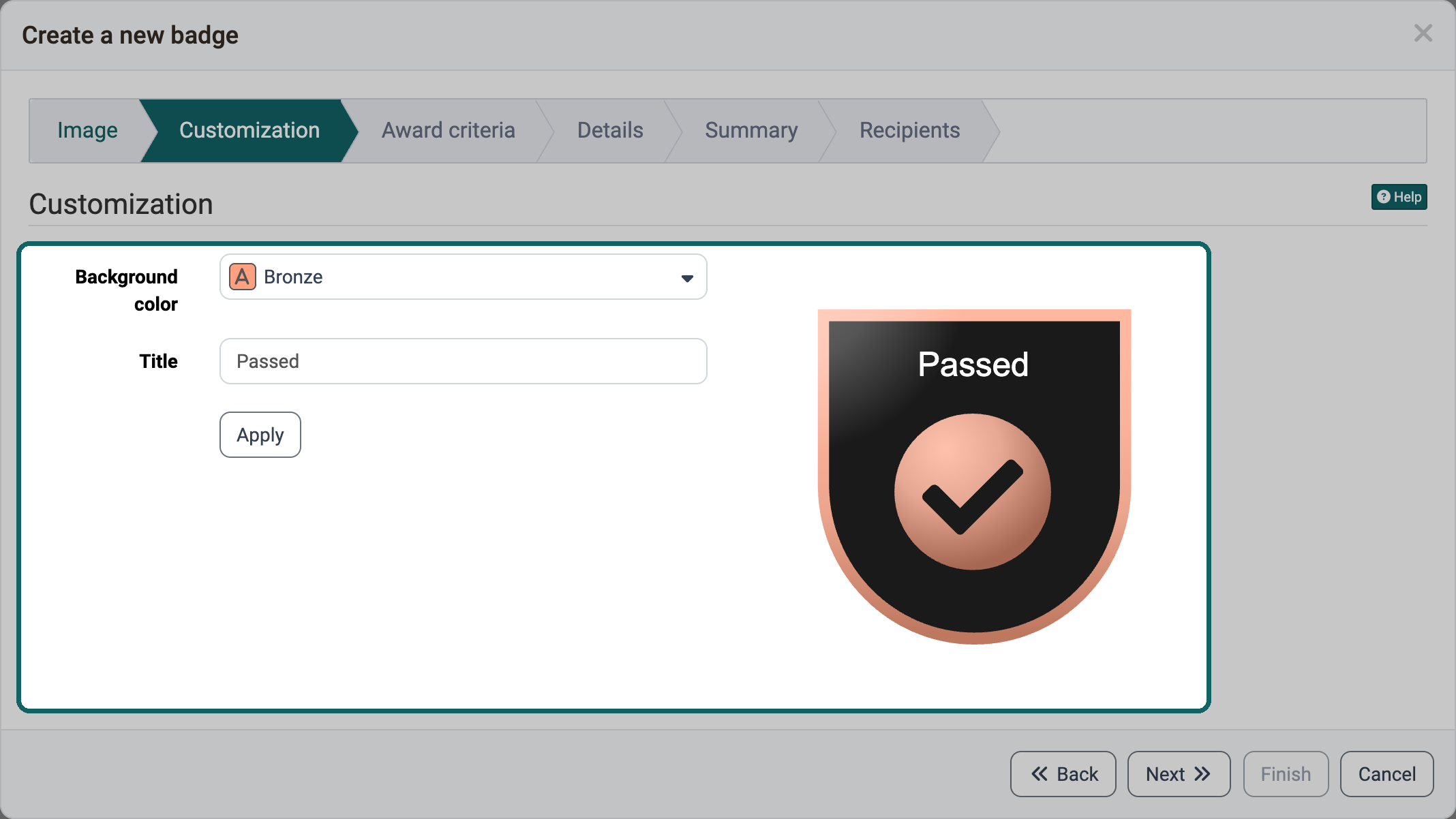
Customization: If the template was created with variables, you can change e.g. the background color and the title of the template. This step only appears for customizable templates.
-
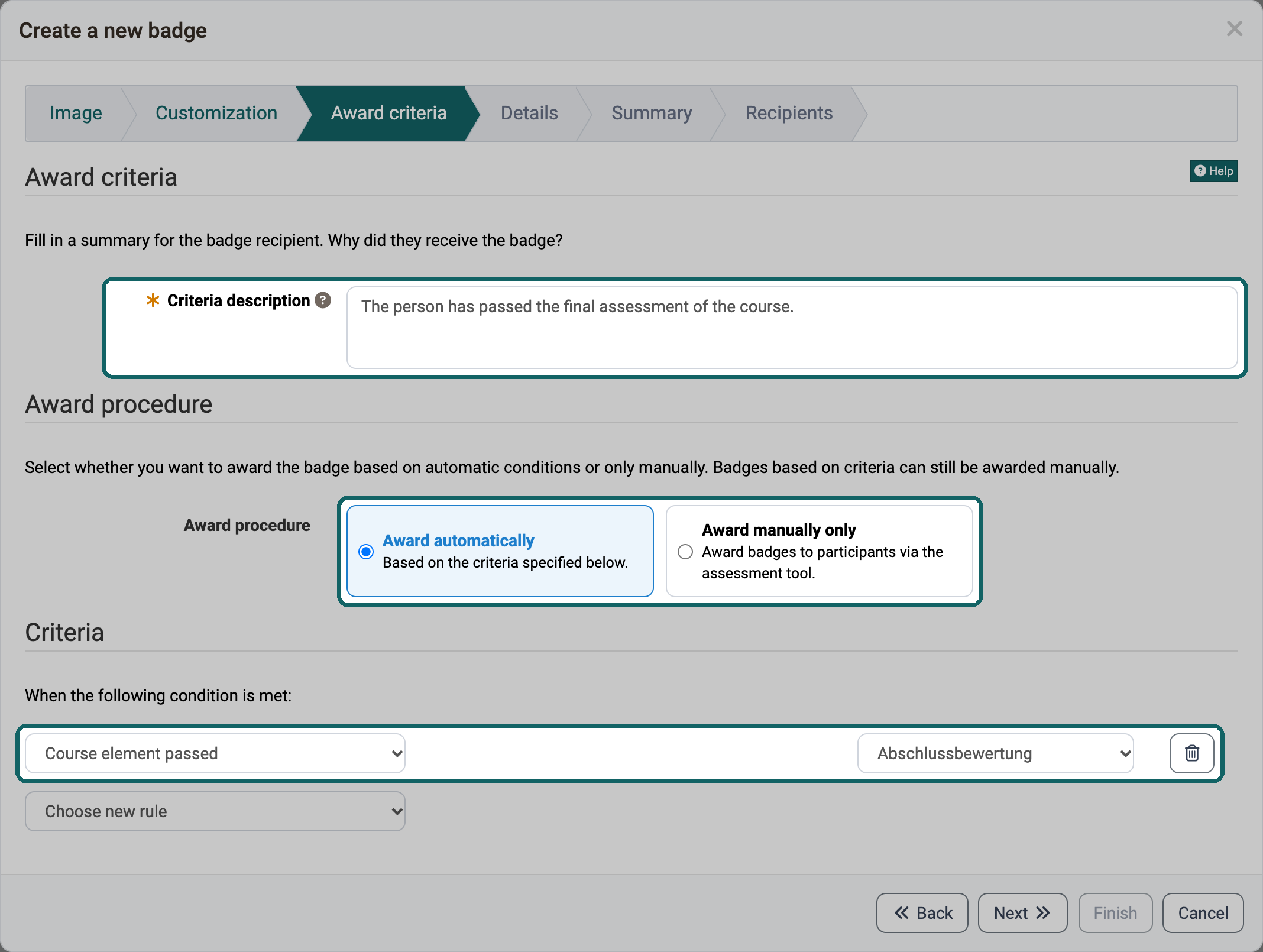
Award criteria: Fill in the criteria description and choose the award procedure: automatic awarding based on the selected criteria, or manual awarding only via the assessment tool. The available criteria are described under Course badges assigned automatically. When you create a new version, this step is skipped and the award criteria remain unchanged.
-
Details: Mandatory details are the name and description of the badge, as well as the issuer. Under "Language" you select the language of the badge. You can additionally add an issuer URL and an issuer email. If LinkedIn organizations have been added in the system administration under
Administration > e-Assessment > OpenBadges > Tab "Configuration", you additionally select one of them under "LinkedIn organization". Under "Expiration" you choose "Never" or "Valid for" with a validity period, e.g. 12 months. OpenOlat assigns the version itself: a new badge starts with the first version, and with each new version OpenOlat increases the version number.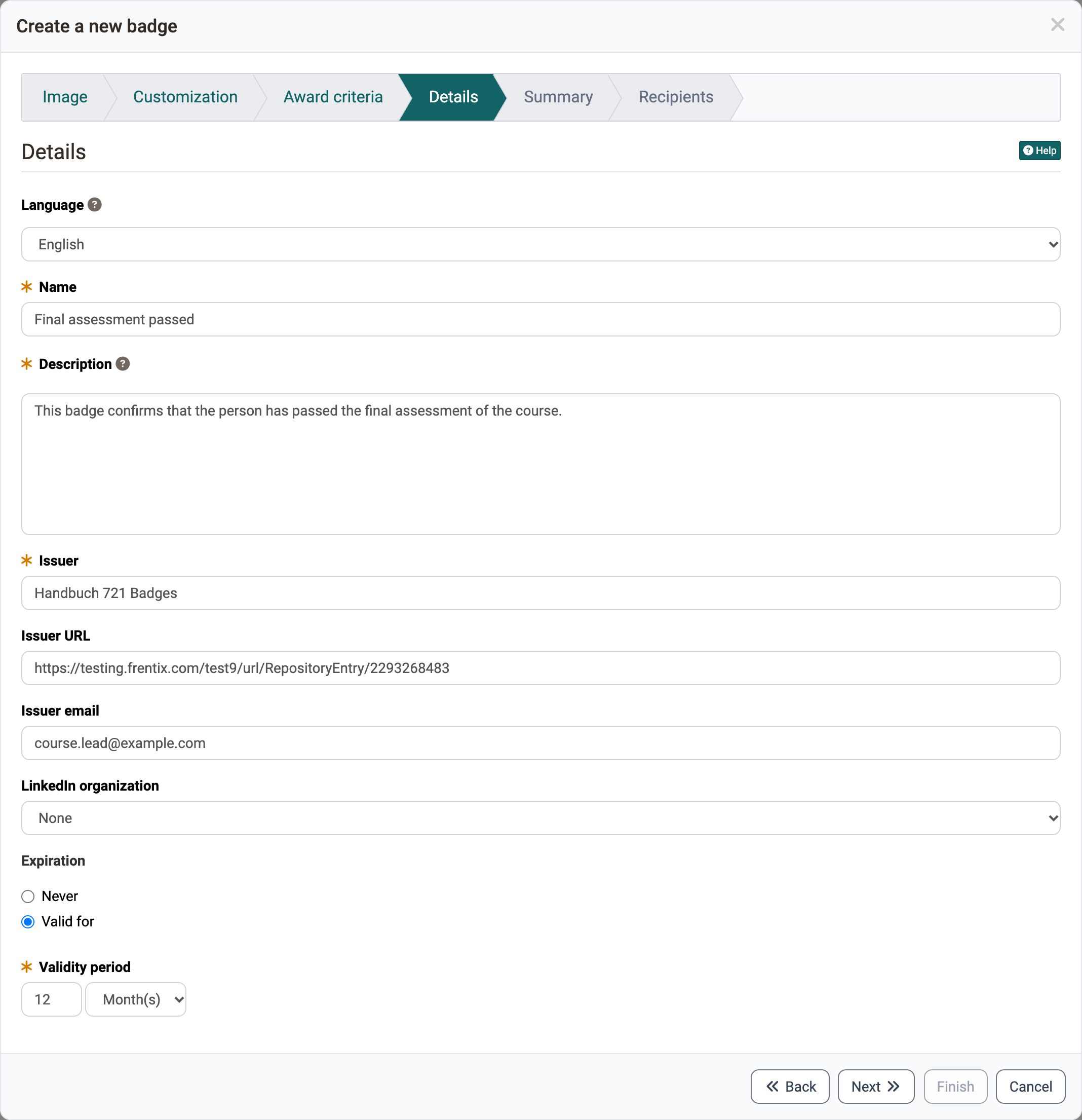
-
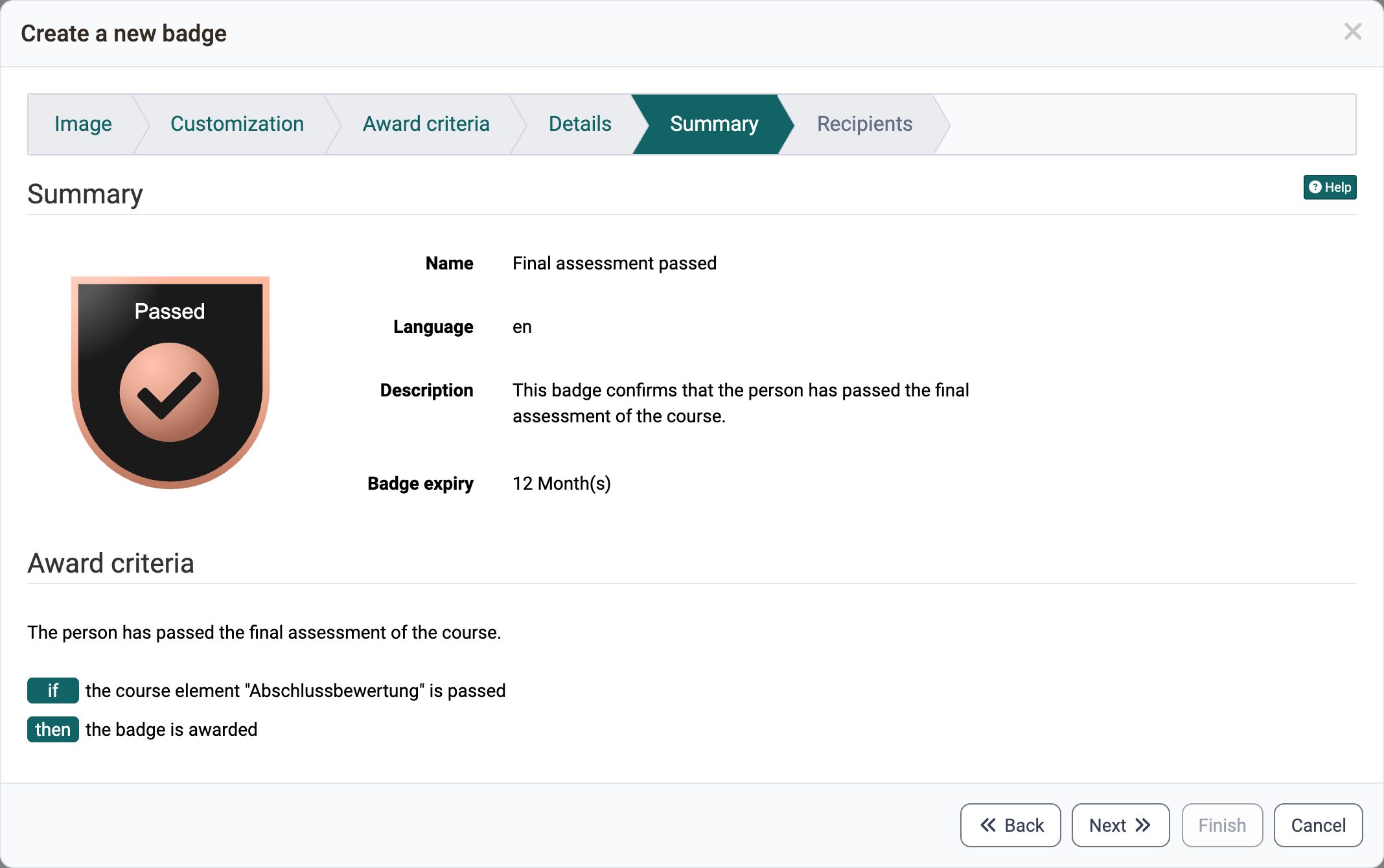
Summary: Shows the image, name, language, description, badge expiry and the award criteria for checking.
-
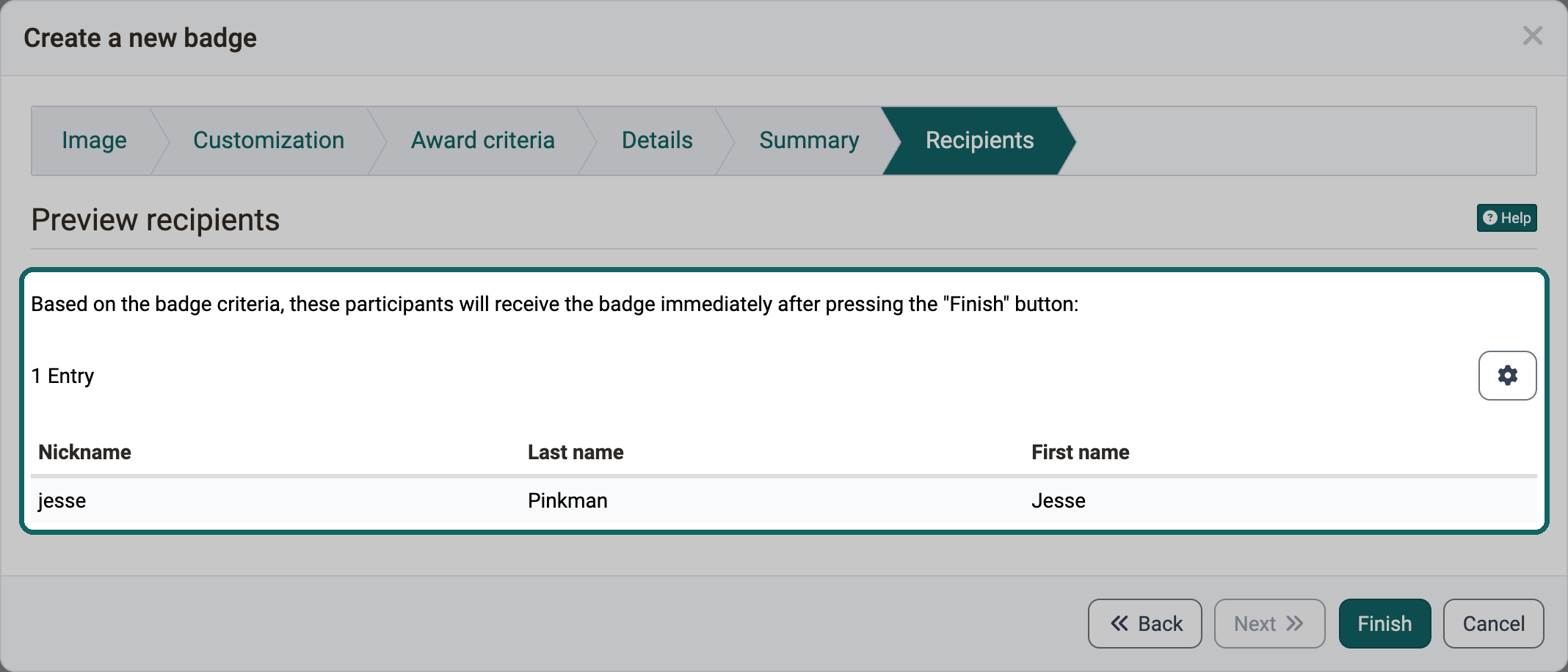
Recipients: Shows in a preview which participants receive the badge based on the criteria immediately after "Finish". For manual awarding, you select the recipients here. This step only appears if the course has participants. As long as the course is not published, the preview shows no recipients.
Note
If entire courses are copied, the option to get badges is also included in the copy.
Where can badges be edited?
As long as a badge has not yet been acquired by anyone, the "Edit" option is available.
If the badge has already been acquired, the "Create a new version and edit" action replaces editing. The image and the description can be changed. The award criteria and the validity period remain unchanged, and badges already awarded keep their previous version. The badge table shows the version in a separate column.
In the course administration:
Course > Administration > Badges > Click on the 3 dots at the end of a row > Option "Edit"
If coaches have also been granted the right to assign badges manually under Course > Administration > Settings > "Assessment" tab > "Badges" section, then an overview is also available for coaches in the "Administration" menu under "Badges". However, coaches cannot create new badges, only assign them manually.
In the course menu (as course owner):
Select a course element to which a badge can be added. (Find the list of course elements with badges here). Then click on the "Badges" tab. If a badge assignment has been set up for this course element, you can also click on the 3 dots at the end of a row and you will find the "Edit" option there.
View of awarded course badges
The awarding of course badges is enabled by course owners in each course under
Course > Administration > Settings > "Assessment" tab > "Badges" section
The right to manual assignment can also be given to coaches here.
If badges have been activated, the Badges option will be available in Course administration after the next login. The rules for awarding badges for the course can be set up here.
If badges have been acquired by participants, they can be seen in the performance overview of the participant concerned.
View awarded badges in LinkedIn and other websites
The display of OpenOlat badges on other websites can be done manually by exporting and importing.
LinkedIn allows you to display certificates and badges in your personal profile. For this, the "Add to LinkedIn" button is available on the detail page of an acquired badge. OpenOlat passes the name, issuer, date of issue, validity period and the URL of the public badge page to LinkedIn, prefilled. The badge is checked there with a host-based verification.
Verify the authenticity of a badge
Administrators can upload a badge file, and OpenOlat will then verify whether it is a validly issued badge.
In addition to host-based verification, badges can also be digitally signed. A digitally signed badge shows a "Verified" label in the badge view.
See Verify badges >
Further information
e-Assessment Administration: OpenBadges >
How do I award badges in my course? >
Course Settings - Tab Assessment >
Assessment tool - overview >
The OpenBadges standard >